COP30 Reflections

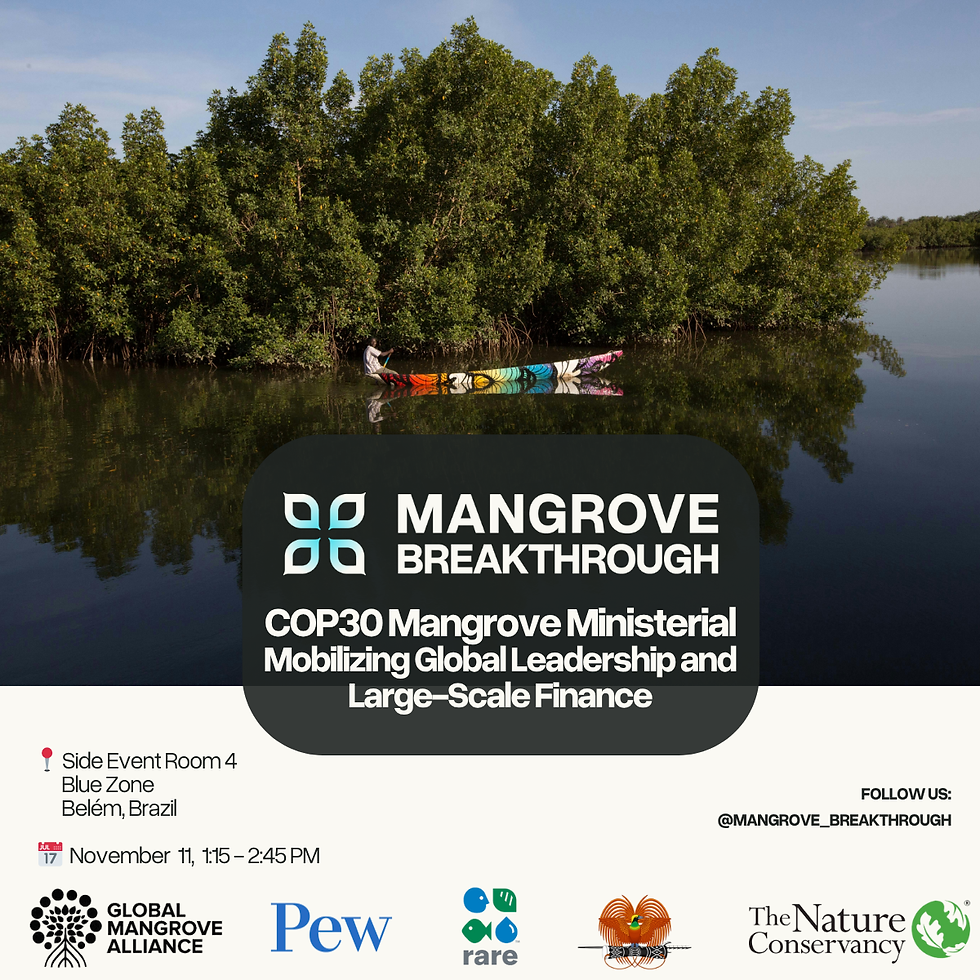
The GMA had an active presence at COP30 this year and oceans were a key priority on the agenda. What were the outcomes? We are so glad you asked.
The ocean community made significant progress to place the ocean as a central pillar of ambition and implementation at COP30, with strong political signals, new commitments and a coordinated push from governments and Non-State Actors (NSA) to scale ocean-based climate solutions. From enhanced NDCs to the Action Agenda and thematic programming, this COP marked a significant step forward in positioning the ocean as indispensable to achieving the Paris Agreement’s goals.
Key Outcomes
Global Mutirão: Ocean was explicitly recognized in the Global Mutirão text as a critical carbon sink and contributor to global climate stability.
Enhanced Nationally Determined Contributions (NDCs): Through the Blue NDC Challenge, countries were encouraged to integrate more ocean-based climate measures into their NDCs. At COP30, six new countries (Belgium, Cambodia, Canada, Indonesia, Portugal, and Singapore) joined the initiative.
Global Goal on Adaptation: The text encourages countries to disaggregate indicators by ecosystem types, explicitly referencing the ocean and coasts, which opens the door to more consistent monitoring of ocean resilience.
Baku-to-Belém Roadmap: The Roadmap highlights marine protected areas, blue carbon ecosystems, coastal community resilience and more transparent ocean governance. The Standing Committee on Finance announced that its 2026 Forum will focus on water systems and the ocean, providing an opportunity to add clarity to the current state of climate finance for ocean solutions and issue concrete recommendations.
COP30 Action Agenda: Built around six thematic pillars, including one focused on nature and coastal/marine ecosystems, the Action Agenda elevated the ocean through coordinated showcases, announcements and multi-sector collaboration. The ocean community delivered the Plan to Accelerate Ocean-based Climate Solutions: A Blue Package and participated in two Showcase Events and a high-visibility Implementation Workshop.
Ocean, Forests & Biodiversity Thematic Days: Elevating Ocean Action
Week 2 of COP30 featured two full thematic days dedicated to oceans, forests and biodiversity, representing one of the strongest ocean profiles in a COP to date. These sessions highlighted implementation, equity, and system-wide collaboration.
Key events included:

Global Mutirão for the Ocean: Accelerating the Ocean Breakthroughs featuring ocean-centered solutions around the Ocean Breakthroughs adding the dimensions of planning and management, indigenous people and local communities and blue entrepreneurship.

Tides of Transformation: Advancing Equitable Coastal Climate Solutions, exploring how inclusive and equitable coastal solutions, from mangrove to saltmarsh restoration, are transforming ambition into action, driving climate resilience, and advancing gender equality across ocean-climate governance.

Coastal Resilience in Action: Nature-based Solutions for National Adaptation, bringing together governments, funders and practitioners to showcase cutting edge approaches to coastal resilience, like the novel Coastal Resilience Methodology developed by The Nature Conservancy, as catalyst for scaling investment and meeting adaptation targets.

Marine Protected Areas and Blue Economy: Pillars of Climate Action in Latin America and the Caribbean, highlighting how MPAs and the Blue Economy can become pillars of a new ocean climate governance for Latin America and the Caribbean.

Mission to Marsh: Integrating Saltmarshes into Coastal Resilience and Climate Action, exploring untapped potential of saltmarshes and the role of the Saltmarsh Breakthrough in accelerating restoration and conservation efforts for the benefit of the people, nature, and resilience.
Overall, COP30 demonstrated unprecedented alignment around ocean-based climate solutions, from enhanced NDCs and adaptation metrics to integrated governance and mobilizing finance. The momentum generated in Belém sets a strong foundation for COP31 and beyond, signaling that the ocean is central to global climate action.
Contribution by Luz Gil, The Nature Conservancy