
Mangrove Champions Initiative: Learning before Restoring

Updated: 3 days ago
A new generation of “Mangrove Champions” along Kenya's coastal frontline is proving that successful mangrove restoration begins by listening to the people who know these forest best.
KWALE COUNTY, Kenya. Priscilla Kagwa, Regional Communications Officer – Wetlands International Eastern Africa
It's just a few minutes past 6am in Tsunza, and three young fishermen are already waist-deep in the mangrove mud. Navigating through the forest, they search for eels hidden beneath the surface, using a hooked metal rod called a migunzu. The traditional fishing method, locally known as mkunga fishing, has been passed from father to son for generations. Nobody taught them this in a classroom. It's exactly the kind of knowledge the Mangrove Champions Initiative was built to learn from.

Launched by Wetlands International and the Global Mangrove Alliance in Kenya, the Mangrove Champions initiative seeks to strengthen locally led mangrove restoration by connecting practitioners, scientists, government agencies and communities through learning exchanges. Rather than promoting one-size-fits-all restoration projects, it recognises that every mangrove landscape is unique and that successful restoration depends as much on local knowledge and community leadership as it does on ecological science.
The first Mangrove Champions restoration expedition, held from 8–12 June 2026, puts this into practice. Over five days, a mixed group of scientists, government officers, NGO staff, community leaders and young champions, travelled together through Bodo, Tsunza and Vanga in Kwale County. They were not teaching communities how to restore their mangroves, but rather exchanging their experiences and learning from each other. This expedition was the first learning exchange of a new initiative designed to transform how mangrove restoration is practiced in Kenya and globally.


The same lesson kept surfacing, worded a little differently at each stop. Forests planted without understanding the ground beneath them tend to die. They come back to life when the people living alongside them actually have something to gain from protecting them.
Planting is Not Restoration
The contrast between Vanga and Bodo tells that story better than any presentation ever could.

At a site in Vanga called Mgera, the team stood among a handful of stunted mangrove trees, the few survivors of of hundreds of seedlings that had once been planted here. Restoration efforts here go back to the early 2000s, when funders cared more about how many seedlings went into the ground than whether they'd actually survive. The reasons are now well understood; species like Avicennia Marina were planted in unsuitable tidal zones, while roads, sea walls and reclaimed land had already disrupted the natural hydrology that mangroves depend on. As a result, most planted seedings died.
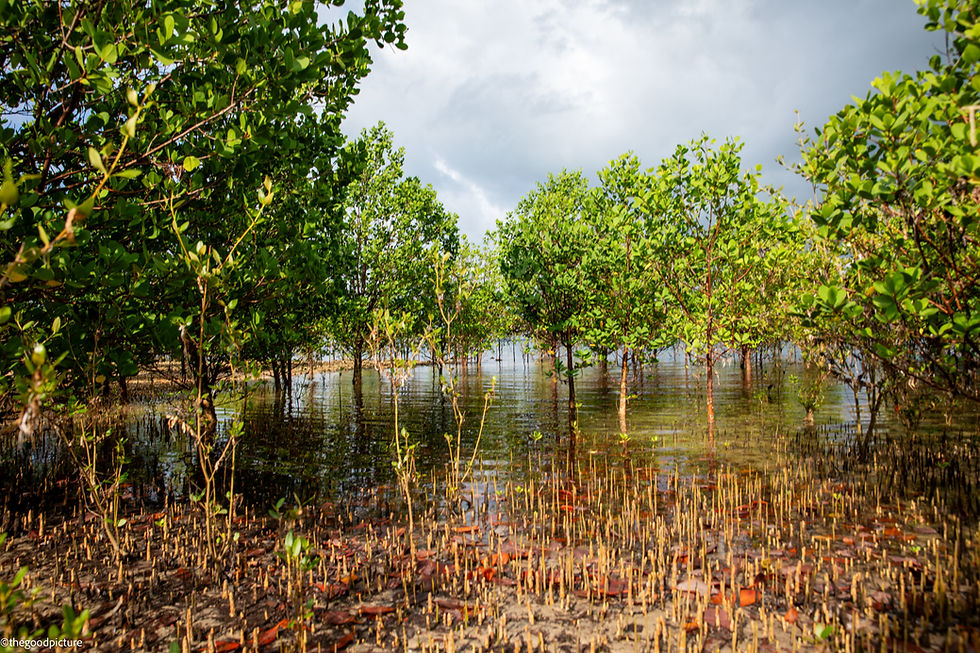
Bodo, a few hours north, tells the opposite story. Here, restoration follows Community-Based Ecological Mangrove Restoration (CBEMR) principles: understand and repair the tidal flow, the sediment, to enable the forest to regenerate on its own, before you plant anything. The results have turned Bodo into one of Kenya's leading examples of community-led restoration.
Throughout the expedition, participants kept circling back to the same conclusion: get the ecology right first. Planting trees alone isn't restoration, and in many cases, nature is perfectly capable of doing the rest.

Community members in Tsunza trace their mangrove losses back even further, to the devastating 1997 El Niño floods, then a wave of illegal logging before Kenya's 2018 ban, and more recent sedimentation caused by the construction along the Dongo Kundu Southern Bypass Highway. Their answer has been the same one, understand the landscape before you try to restore it.
When the Forest Pays
Across all three sites, another message became clear that ties these three places together: people protect what actually helps them.
In Bodo, income generation from mangroves feeds into a revolving eco-credit fund. That fund pays school fees, fixes up houses and helps get small businesses off the ground.
“The income from mangroves helps in educating our children, building and renovating our houses and help grow our eco-credit fund.” Community member, Bodo
Vanga runs the same idea on a bigger scale. The Vanga Blue Forest Project, a community-led blue carbon initiative that started in 2019 that has generated carbon credit revenues since 2022. Forty percent of that revenue goes straight back to Vanga village. It's paid for renovated classrooms, 302 new school desks, equipment for the local health facility, a borehole in Kiwegu and a new road out to the rice farms.
“Transparency is key for sustainability. Uwazi na ukweli ndio mradi unaendelea.” Vanga Blue Forest Project members
In Tsunza, declining fish stocks have pushed families to diversify their livelihoods by establishing mariculture ponds, where fish can be raised to a marketable size themselves rather than relying on what's left in the ocean.
"Kutokana na kupungua kwa kiasi na ukubwa wa samaki baharini, imebidi sisi kama wanajamii tutengeneze madibwi ili tukuze samaki ambao watatupea kipato kizuri. (Due to the decline in the quantity and size of fish in the ocean, we have had to establish fish ponds to raise fish that can provide us with better income.” Mzee Mwatela, Chairman, Tsunza Beach Management Unit
Conservation Rooted in Culture
In Bodo, some of the healthiest, biggest stands of mangrove grow in spots that no law protects. They are sacred shrines and it is culture, not conservation policy, that has kept them standing for generations.
“No one can cut a mangrove tree here. It is sacred ground. We have several of these shrines, and in these areas the mangroves are healthy, big, and thriving.” CFA Chairman, Bodo
Who Carries the Work
Women and young people carry most of this work across all three sites and they are increasingly shaping the future of mangrove restoration. In Vanga, women lead the restoration and organise the beach clean-ups, often through savings groups or chamas that fund small businesses like soap-making and dress-making alongside conservation work. Young people patrol the forest, report illegal cutting and are just as likely to film it on their phones as talk about it.
“The youth actively participate in awareness creation by producing and sharing videos of conservation activities, assist in organizing community elections and mobilize peers for mangrove clean-ups." Hamadi Tsunusi, Vanga Blue Forest Project
Kids at Vanga and Tsunza Primary School already knew the mangrove species by their local names, Msisi for Rhizophora mucronata, Visiki for the breathing roots of Avicennia marina, long before any scientist turned up to teach them.
©Curtis Obimbo – WWF Kenya ©PKagwa-Wetlands International
What It All Adds Up To
By the end of the expedition through Bodo, Tsunza and Vanga, participants took multiple lessons back into the wider Global Mangrove Alliance network. They had witnesses that restoration is an ecological problem before it's ever a numbers problem.
People look after what actually benefits them.
Women and youth are central to mangrove conservation across all three sites, taking leading roles in restoration activities and community organisations.
Culture can do conservation work that no policy ever could.
You can learn more standing in a mangrove forest for a week than you do in any workshop.
Henry Komu, a scientist from the Kenya Forestry Research Institute, spent a week living alongside fishing families in Tsunza and said the trip broke down the usual wall between researchers and the communities they study. "That was the day the 'teacher' became the student," he said, "and I accepted the promotion with a smile."

The First Stone Never Moves
One of the expeditions most memorable reflections came from Nathaniel Mwangeka of WWF-Kenya, who put it best, using the traditional three-stone cooking fire found along the Kenyan coast as a metaphor.
The first stone is big and doesn't move. It's dug into the ground long before anyone else shows up, and it represents the community.
The second stone is smaller and can shift a bit. That's government, standing for leadership and policy.
The third stone, the smallest and easiest to move, represents NGOs, projects, funding cycles that arrive when they're needed and eventually leave again.
“What struck me in Bodo was that, for once, we were not acting like the third stone pretending to be the first. We did not arrive to lecture the community on how to hold the pot. Everyone took turns being teacher and student. No one owned the classroom; it was the mangrove forest itself.” Nathaniel Mwangeka Mwambi, WWF-Kenya
His reflection captures the spirit of the Mangrove Champions Initiative: learning is most powerful when expertise flows in every direction.


