
Mobilizing Mangrove-Positive Action for the World’s Coasts

International Day of Forests
Lanie Esch & Dominic Andradi-Brown, Oceans Conservation, World Wildlife Fund
Mangrove forests sit at the frontline of the biodiversity and climate crises. These remarkable coastal ecosystems provide services worth up to US$ 800 billion per year as they protect shorelines from storms, store immense amounts of carbon, support fisheries, and provide benefits for millions of people. Despite their value, mangroves continue to disappear in many parts of the world.
For decades, conservation efforts have tried to halt mangrove loss. While progress has been made, the scale of action has not kept pace with the scale of the challenge. Many industries operating along tropical coasts—from aquaculture to tourism—have often been drivers of mangrove loss. But this is beginning to change.
Across the world, businesses are recognizing that healthy mangrove ecosystems reduce risks to their operations and the places and communities their operations depend on while also improving resilience of their coastal economies. As financial institutions increasingly show interest in nature-positive investments, the opportunity is growing for businesses to become powerful contributors to mangrove recovery.
This shift in private-sector perspectives is captured in a new concept gaining traction globally: mangrove-positive action.
What Does “Mangrove-Positive” Mean?
WWF recently convened partners from across the Global Mangrove Alliance and the Mangrove Breakthrough to develop shared definitions of what mangrove-positive means and what it means to be a mangrove-positive business contributor. The resulting definitions are intended to align with the broader nature-positive movement, which seeks to halt and reverse nature loss.
Mangrove-positive Defined
Mangrove-positive is a global goal to halt and reverse mangrove loss measured from a 2020 baseline by increasing mangrove protection, restoration, and sustainable management while transforming systems that drive mangrove loss.
By 2030
Mangrove forests should be visibly and measurably on the path to recovery.
By 2050
Mangrove ecosystems should have recovered, delivering meaningful benefits for nature, people, and the economy.

Bending the Curve of Mangrove Loss: A mangrove-positive goal to halt and reverse mangrove loss measured from a 2020 baseline.
Achieving this goal will require far more than traditional conservation and restoration projects. It will require actions from sectors that interact with mangroves every day — from seafood supply chains and coastal tourism to infrastructure development and finance.
How Can a Business Contribute to the Mangrove-Positive Goal?
Businesses can play a critical role in shaping the future of coastal ecosystems.
A mangrove-positive business contributor is one that derives value from mangrove ecosystems, including from the protections mangroves provide, and actively channels funding or supports management practices towards mangrove conservation and restoration.
Many mangrove-positive business contributors may not operate directly within mangrove landscapes, but have activities that influence, depend on, or benefit from mangrove ecosystems.
Mangrove-Positive Business Contributor Definition
A business that contributes to the mangrove-positive goal is one that (i) does not contribute to mangrove loss while (ii) sustainably deriving value from, depending on, and/or benefiting from the functions of mangrove ecosystems, and (iii) channels finance and/or practices toward mangrove conservation and restoration. These businesses include but are not limited to those in coastal agriculture and aquaculture, sustainable resource use, blue carbon, infrastructure, hospitality and tourism, as well as other downstream actors.
Sectors with Mangrove-Positive Potential
Many industries have the potential to contribute to mangrove recovery, including:
Coastal aquaculture and fisheries
Agriculture in coastal landscapes
Blue carbon and climate finance
Tourism and hospitality
Coastal infrastructure and development
Seafood and commodity supply chains
To help mobilize mangrove-positive contributors, the Mangrove Breakthrough has released a series of Mangrove Finance Handbooks designed to guide microfinance institutions, project developers, and financial institutions in supporting mangrove-positive investments.
But what does this look like in practice?
A Community-Led Mud Crab Fishery Improvement Program
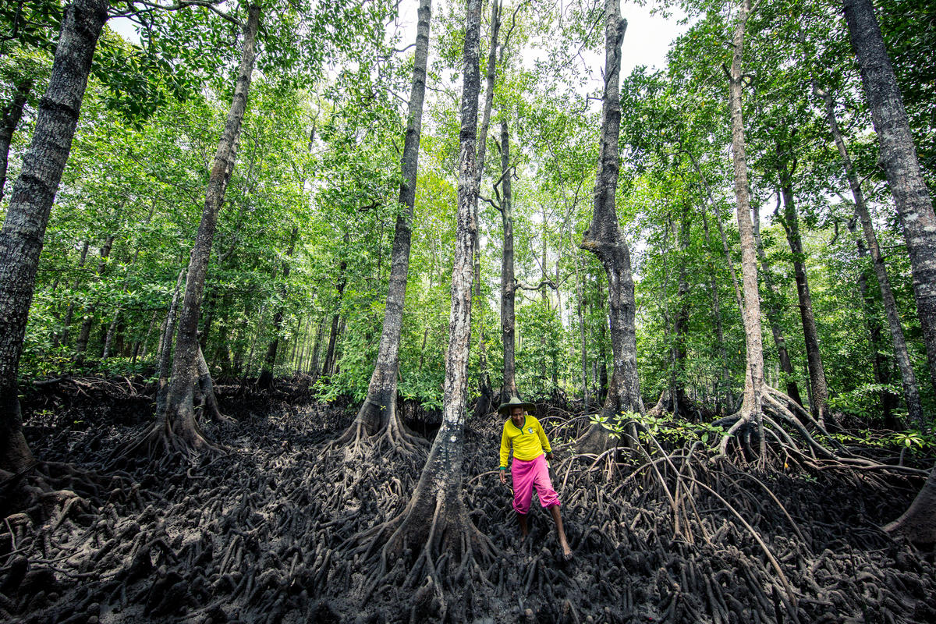
Member of the crab fishing cooperative in Kei Kecil, Indonesia searching for mud crabs in the mangroves. (© James Morgan / WWF-US)
A mangrove-positive fishery can be built through a community-led approach that balances sustainable harvesting with ecosystem protection. In Southeast Maluku, WWF-Indonesia and partners launched the Fishery Improvement Program for sustainable management of mud crab stocks – a fishery worth up to US$ 1,400 per month for the local fishing community.
The Program implemented a minimum catch size, protections for egg-bearing crabs, closed spawning locations to fishing, and a training program teaching local fishers to use traditional bamboo traps – a method with low impact on the surrounding mangrove ecosystem. To ensure compliance with the improvement program, a community-based monitoring group was established to track resource use.
These combined efforts help maintain healthy crab populations while protecting the mangrove ecosystems they depend on.
The result is a model of community-based fisheries management in which the very base of the mud crab supply chain aligns with mangrove-positive action —rooted in conserving mangrove habitat, regenerative harvesting practices, and local stewardship that sustains both biodiversity and livelihoods over the long term.
Belize: Encouraging Mangrove-Friendly Businesses

Naia Resort and Spa – Second place winners of the Aesthetics and Creativity category in the 2025 Mangrove Friendly Development Challenge. This business prioritizes minimizing environmental impact when building new infrastructure on their property, integrating nature into every guest’s experience. (© WWF-Belize)
Across the Caribbean, Belize is home to some of the region’s most important mangrove ecosystems. These forests protect coastal communities, support fisheries, and help sustain the country’s thriving tourism industry.
WWF is supporting the Belize Mangrove Friendly Development Challenge, an initiative designed to encourage individuals, organizations, and businesses to adopt practices that enhance and preserve mangrove ecosystems.
The Challenge works with coastal business entities—including tourism operators, developers, and local enterprises—to recognize and promote mangrove-friendly practices such as:
Protecting existing mangrove habitat
Supporting restoration projects
Reducing coastal impacts from development
Showcasing sustainable development designs within mangrove landscapes
Educating visitors about the value of mangroves
The Mangrove Friendly Development Challenge is a celebration of innovation, collaboration, and a shared commitment to safeguarding mangrove ecosystems. By recognizing businesses that actively conserve mangroves, the initiative helps demonstrate that economic success and ecosystem conservation can go hand in hand.
Mobilizing from Local Action to Global Impact
From sustainable fisheries in Indonesia to mangrove-friendly businesses in Belize, these initiatives illustrate a broader shift in how mangroves are valued. Rather than seeing economic activity and conservation as competing goals, mangrove-positive approaches recognize that healthy ecosystems are the foundation of resilient coastal economies.
Scaling solutions that contribute to mangrove-positive outcomes will be essential to achieving the global goal of halting and reversing mangrove loss.
With the right partnerships, investments, and policies in place, mangrove-positive action can help conserve coastal ecosystems while supporting the long-term resilience of the communities and industries that depend on them.
Because protecting mangroves is not just about conserving forests. It is about building stronger coastlines, thriving livelihoods, and a resilient future for people and nature alike.


