
The World’s Mangrove Forests Show Net Gain Globally

Dan Friess & Zhen Zhang
Tulane University
Mangrove forests have long been considered one of the world’s most threatened ecosystems, to the extent that in 2007 a world-leading group of scientists concluded that by the end of the century we might see “a world without mangroves”. Mangrove areas have long been converted to human land uses such as aquaculture and agriculture, have been damaged by infrastructure development, and impacted by pollution. This is on top of the myriad natural processes that affect mangroves, such as tropical cyclones and shoreline erosion. Mangrove loss has caused substantial loss of biodiversity alongside losses of the important ecosystem benefits that they provide to coastal communities across the tropics.
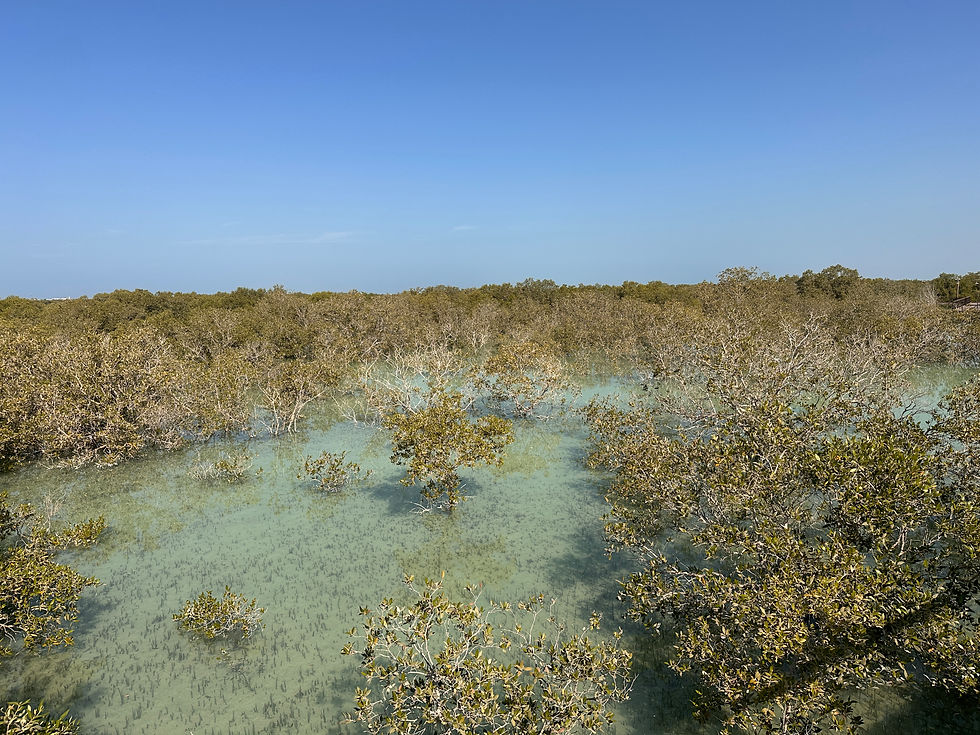
Turning the Tide on Mangrove Loss
While we have generally considered mangroves to be heavily threatened, our recent research published in the journal Science suggests that we may have turned the tide on mangrove loss and degradation. We showed that mangrove loss rates have slowed since 2000, and a large proportion of mangrove loss has been offset by the regeneration and expansion of new mangroves, particularly in river estuaries and along accreting shorelines. As a result, mangroves globally have in fact shown an overall net gain since around 2010.
We also quantified rates of mangrove degradation, which while higher than rates of deforestation, have also shown a substantial drop over time. We also showed that many of the world’s remaining mangroves are growing and getting thicker through time.

Mapping Global Dynamics
To uncover these new global mangrove dynamics, we created a novel global mangrove canopy cover dataset. This dataset provides us annual information on mangrove extent and covers approximately 40 years, from the early- to mid-1980s until 2023. Traditional remote sensing approaches treat mangrove maps as binary e.g., a pixel is either mangrove or not mangrove. Our approach using canopy cover gives us a more nuanced understanding of both habitat quantity and habitat quality.
We can use this dataset for two purposes. Firstly, it shows annual change in mangrove area, to monitor broad changes in extent driven by deforestation and loss, or regeneration and expansion of mangroves into new locations. Secondly, it shows us more subtle changes in canopy cover within the persistent mangrove area, which helps us to decode areas of degradation or canopy thickening. This annual dataset is freely available for all countries here for anyone to use and download.
Building on Our Conservation Gains
While this could be seen as a sign of conservation optimism, the hard work to protect the world’s mangroves is not yet done, and there are many locations around the world where mangroves are being lost. The results of this study show the importance of mangrove conservation to achieving the Global Mangrove Alliance’s goals of (1) Halting Loss; (2) Restoring Half; and (3) Doubling Protection. Mangroves around the world already show great capacity to regenerate and expand, so if we can stop remaining deforestation then mangroves would show an even greater net gain around the world. New mangroves take time to grow to a level that they can provide the same ecosystem benefits as a mature mangrove forest, so it’s important that we protect these important mature forests now. The rapid regeneration and expansion of mangroves also shows that they can colonise new areas quickly if physical conditions are right, so we need to prioritise restoration techniques that restore the physical conditions that mangroves need.
This is an exciting time for mangroves, and we have seen huge momentum behind their conservation and restoration around the world. Understanding mangrove dynamics is important for guiding suitable conservation and restoration; at Tulane University’s Mangrove Lab we are proud to be a member of the Global Mangrove Alliance, helping provide the information that can inform effective conservation decision making.
Dive Deeper
Download the paper here: https://doi.org/10.1126/science.aec9773
Access the data here: https://zhenzhang.users.earthengine.app/view/globalmangrovedynamic

