
Partnering for Hope

GMA Member INVEMAR and their partnership with coastal village.
Authored by: Liseth Castillo Mahecha, Scientific Communications Professional at INVEMAR.
The Ciénaga Grande de Santa Marta is Colombia’s largest coastal lagoon and one of the most productive estuarine systems in the world. It hosts the largest mangrove coverage in the Colombian Caribbean—an ecosystem that sustains both biodiversity and the livelihoods of thousands of families who depend on artisanal fishing.
Recognized as a Ramsar Wetland, Biosphere Reserve, and Important Bird Area, the Ciénaga acts as a natural barrier against storms, a major blue carbon sink, and a vital source of income for local communities.
In this complex landscape operates INVEMAR—the Marine and Coastal Research Institute of Colombia—a non-profit scientific institution affiliated with the Ministry of Environment and Sustainable Development. For more than three decades, INVEMAR has been a key authority in marine and coastal research in the country, generating scientific knowledge, providing technical guidance, and supporting environmental decision-making along Colombia’s coasts.
Here, where freshwater from the Magdalena River meets the Caribbean Sea, the balance is fragile. For decades, this territory has been shaped by environmental degradation, limited state presence, and the neglect of communities that learned to live with water—building their homes on stilts, known in Colombia as ‘palafito’, and relying almost entirely on the mangrove ecosystem.
Basic services remain scarce. Electricity is intermittent, access to clean water is limited, and in some areas, education is still out of reach.
In a place like this, trust cannot be imposed—it must be built. INVEMAR understood this early on. It has spent more than 20 years navigating these waters, monitoring ecological change and, above all, listening to the people who call this place home.
Through long-term ecological restoration projects, INVEMAR has developed processes grounded in science and community participation. One of these efforts is the project Mangrove conservation and restoration with communities of the Ciénaga Grande de Santa Marta, funded by the Government of Spain through the Global Mangrove Alliance.
Its goal was ambitious: to restore 1,000 hectares of mangroves and contribute to the conservation of nearly 17,000 hectares more—bringing together scientific knowledge, local communities, and institutional coordination.
History of village.
Before mangrove restoration, there was silence.
In the late 1990s and early 2000s, the palafito villages of the Ciénaga Grande were caught in the crossfire of violence. In Bocas de Aracataca, armed incursions marked the lives of its inhabitants with killings, forced displacement, and a deep fracture in the social fabric.
In February 2000, armed men entered the village. Families were separated, fishermen were interrogated, and several were murdered. The attack triggered the displacement of thousands, leaving the community nearly abandoned.
Many never returned. Others came back years later—not because safety was guaranteed, but because of something stronger: belonging.
Those who returned found a wounded territory, but one that was still alive.

What mangroves provide for this community.
In Bocas de Aracataca, a palafito village in the southeastern part of the Ciénaga, life still follows the rhythm of water. Among channels, rivers flowing down from the Sierra Nevada de Santa Marta, and mangrove roots, the community has built its livelihood around fishing.
But that balance has been disrupted.
The expansion of cattle ranching and crops such as oil palm and banana has reduced vegetation cover and altered water flows. These changes have affected water quality and weakened the mangrove ecosystem—directly impacting fish availability and local food security.
One of the most visible signs of this degradation is the spread of floating aquatic plants that blanket the water’s surface. These green mats obstruct navigation, reduce oxygen levels, and make fishing increasingly difficult.
When mangroves decline, it is not only biodiversity that is lost—livelihoods are at risk.
Mangrove restoration through partnership.
Mangrove restoration in the Ciénaga has not been imposed from the outside—it has been built collectively.
Through partnerships between INVEMAR, the Global Mangrove Alliance, Mangrove Breakthrough, Conservation International, and national institutions, priority areas for restoration were identified. One of them was Caño Pancú, a key water channel for both ecological balance and fisheries.
In this area, more than 38 hectares of mangroves were restored alongside the community. The work included planting 700 seedlings and rehabilitating approximately one kilometer of the channel through manual cleaning and dredging.
The impact goes beyond what is visible. Mangroves in this region are estimated to store over 300 tons of carbon per hectare, most of it in their soils. When degraded, they can lose around 90 tons of carbon per hectare from aboveground biomass, contributing to climate change.
Restoring them, therefore, is not only about recovering ecosystems—it is about protecting one of the most important natural carbon reserves.
At the same time, workshops and field activities strengthened local capacities. Community members helped identify restoration areas, participated in on-the-ground actions, and engaged in participatory monitoring.
Science was no longer external. It became part of the territory.
How partnership has changed narrative for villagers.
From loss to resilience
Today, the story told in the Ciénaga is different.
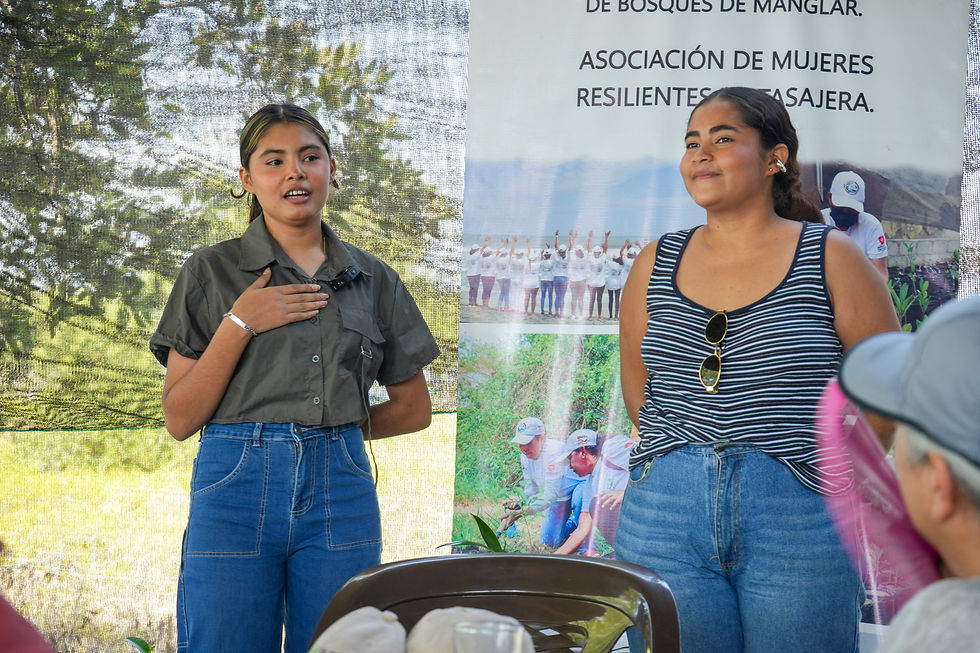
Community participation—balanced between men and women—reflects a level of ownership that goes beyond technical intervention. In August 2025, it was the community itself that led a mangrove planting day, a sign of a relationship rebuilt from within.
In a place where income opportunities have long been limited, restoration has come to mean something more than environmental action. It has become a pathway.
Community members describe it clearly: this process has not only helped restore mangroves, but also created opportunities linked to caring for the territory. It has strengthened social bonds, sparked interest among young people and adults, and shown that protecting nature can also mean jobs, learning, and well-being.
Today, mangroves are no longer seen only as an ecosystem. They are understood as a foundation for the future.

And so, the commitment remains.
Where there was once fear, there is now organization. Where there was loss, there is now the beginning of abundance.
The mangrove, with its intertwined roots, is growing again. And with it, so is the community that chose to return.
“We embraced mangrove restoration as a real opportunity for our territory and for our families. This process allowed us to strengthen our local capacities, especially in mangrove monitoring, the proper use of equipment, and observing changes in the ecosystem, giving us greater confidence and assurance in what we do.”, Community of Bocas de Aracataca, Puebloviejo.
Source: Invemar. 2026. Raíces que Sanan: Historias Vivas de la Restauración del Manglar en la Ciénaga Grande de Santa Marta. Serie de Publicaciones Generales N° 141. Santa Marta. 36p. (Spanish) Available at: https://n2t.net/ark:/81239/m96m72


