
The GMA Policy Working Group Launches its 2026 Work Program

The Global Mangrove Alliance (GMA) brings together more than 100 member organizations across 40+ countries in support of its 2030 goals: to halt mangrove loss, restore half of all degraded mangroves, and double long-term protection of remaining mangrove areas. Achieving these goals requires enabling policy frameworks at every level, from local governance to international agreements.
The GMA Policy Working Group (PWG) is a community of practice advancing these kinds of policies — connecting more than 40 member organizations and all 14 national chapters to facilitate exchange and learning, support the development of policy guidance and knowledge products, and drive mangrove policy uptake in both national frameworks and international processes.
In late March 2026, the PWG held its first peer-learning call of the year, marking the launch of an ambitious 2026 work program and bringing together members from North America, Latin America and the Caribbean, East and West Africa, Asia, the Middle East, and international organizations working across multiple regions. For many, it was the first opportunity to meet as a group this year, and for the PWG, a meaningful step in reactivating as a collaborative platform for the year ahead.
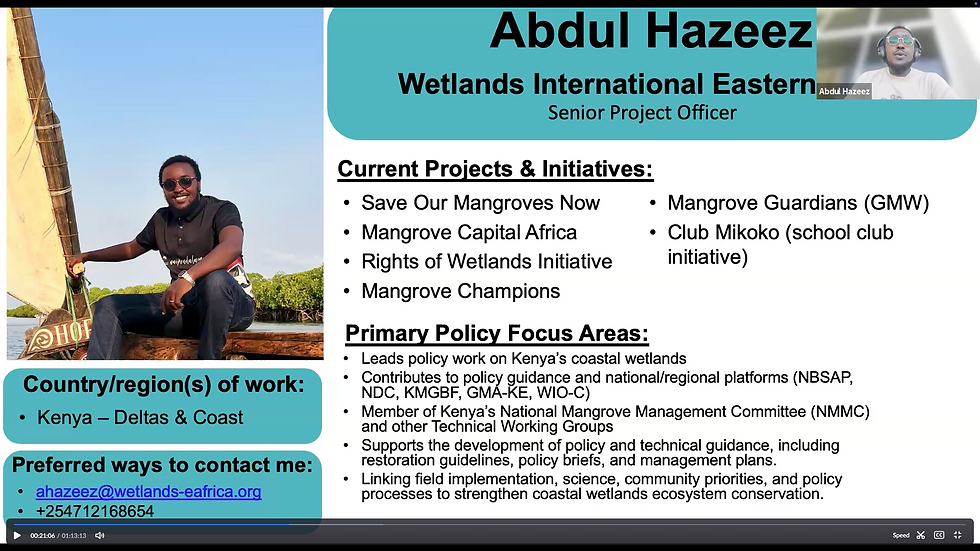
The sessions opened with a structured networking segment in which members presented their organizations, their geographic focus, and the policy work they are currently advancing. These snapshots, which have since been compiled into a shared PWG member resource, offered a vivid picture of the breadth of mangrove policy work currently underway across the Alliance, from national legislation and blue carbon strategies to community stewardship frameworks and international convention engagement. The networking segment was followed by a presentation of the PWG's 2026 work program, developed in coordination with the GMA’s other policy workstreams, including the Mangrove Breakthrough and the NDC Task Force. The program is organized around priority themes that members identified as central to their work: cross-sectoral integration, legal and governance frameworks, and financing and scaling models.
Planned outputs for the year include a quarterly peer-learning call series, an update to the 2023 Mangrove Law and Policy Brief incorporating new case studies, improvements to the GMA Policy Knowledge Hub, and a set of policy briefs addressing the upcoming Rio Convention COPs and synergies between these frameworks, as well as contribution to an e-learning course on mangrove governance.
The diversity of policy work presented by members was one of the most striking features of the calls. Geographically, the group spans nearly every major mangrove region in the world.
In Latin America and the Caribbean, multiple organizations presented work in Ecuador around sustainable aquaculture policy and community stewardship agreements, while WWF Mexico shared progress on the GMA Mexico Chapter, working on national climate policy, legal protection, and blue carbon mainstreaming. The Ocean Foundation presented blue carbon and market development work across Puerto Rico, Mexico, and Cuba, and Rare's Coastal500 initiative has already contributed to landmark national policies in Honduras and the Philippines.
In Africa, Conservation International Liberia and Nature for Mangroves (Sierra Leone) described advances in national mangrove governance and youth-led advocacy respectively.
In Asia, Wetlands International Philippines shared recent progress on a National Blue Carbon Action Plan and coastal zone management legislation, while SACIWaters described emerging policy advocacy efforts in India.
In the Middle East, Goumbook's MENA Oceans Initiative is building a regional knowledge hub and developing restoration guidelines to support NDC integration across eight countries, and Landesa shared tenure reform advisory work spanning Indonesia, Cambodia, Thailand, and India.

Across the presentations, several thematic convergences emerged, pointing to shared priorities and opportunities for collaboration. Blue carbon policy is advancing simultaneously across multiple regions: Fauna & Flora is supporting Kenya's national blue carbon strategy, Wetlands International Philippines recently launched a National Blue Carbon Action Plan, Conservation International Liberia is working to integrate blue carbon into a national carbon market framework, and The Ocean Foundation is advancing blue carbon legislation and market development in Puerto Rico and Mexico. NDC integration runs through the work of members across nearly every region, from Pew's science-based NDC support programs in Latin America and the Western Indian Ocean, to Wetlands International's role in the global NDC Task Force, to Goumbook's regional hub in the Middle East. Sustainable aquaculture, as a policy lever for mangrove conservation, is featured in the work of both Conservation International and The Nature Conservancy in Ecuador, as well as Conservation International’s work in Liberia and Landesa’s advisory work in Cambodia. Science-policy linkages were central to presentations from Pew, Wetlands International Eastern Africa, IUCN, and New York Botanical Garden, while land tenure and community-based management framed the work of Landesa and Nature for Mangroves. Marine and coastal spatial planning, locally-led coastal management (Rare's Coastal500), monitoring and data for policy (Wetlands International, Fundação Florestal), and cross-sectoral integration into climate, biodiversity, and development planning (WWF Mexico, Wetlands International Philippines, IUCN) all featured prominently across presentations.
The range of themes reflects both the complexity of the mangrove policy landscape and the complementarity of approaches within the group, making the PWG a well-positioned platform for cross-regional learning and the co-development of practical policy guidance.
The 2026 work program is already underway. The next quarterly call, planned for Q2, will dive deeper into some of our members’ work on legal and governance frameworks at the national level. In the coming weeks, members will provide inputs, contributions, and case studies as we begin developing our planned knowledge products.
If you are a GMA member working on mangrove policy and are not yet part of the Policy Working Group, we encourage you to get involved — reach out to the PWG lead, Adriana Vidal (Adriana.vidal@iucn.org), to learn more about how to participate and contribute to the work planned for 2026.

